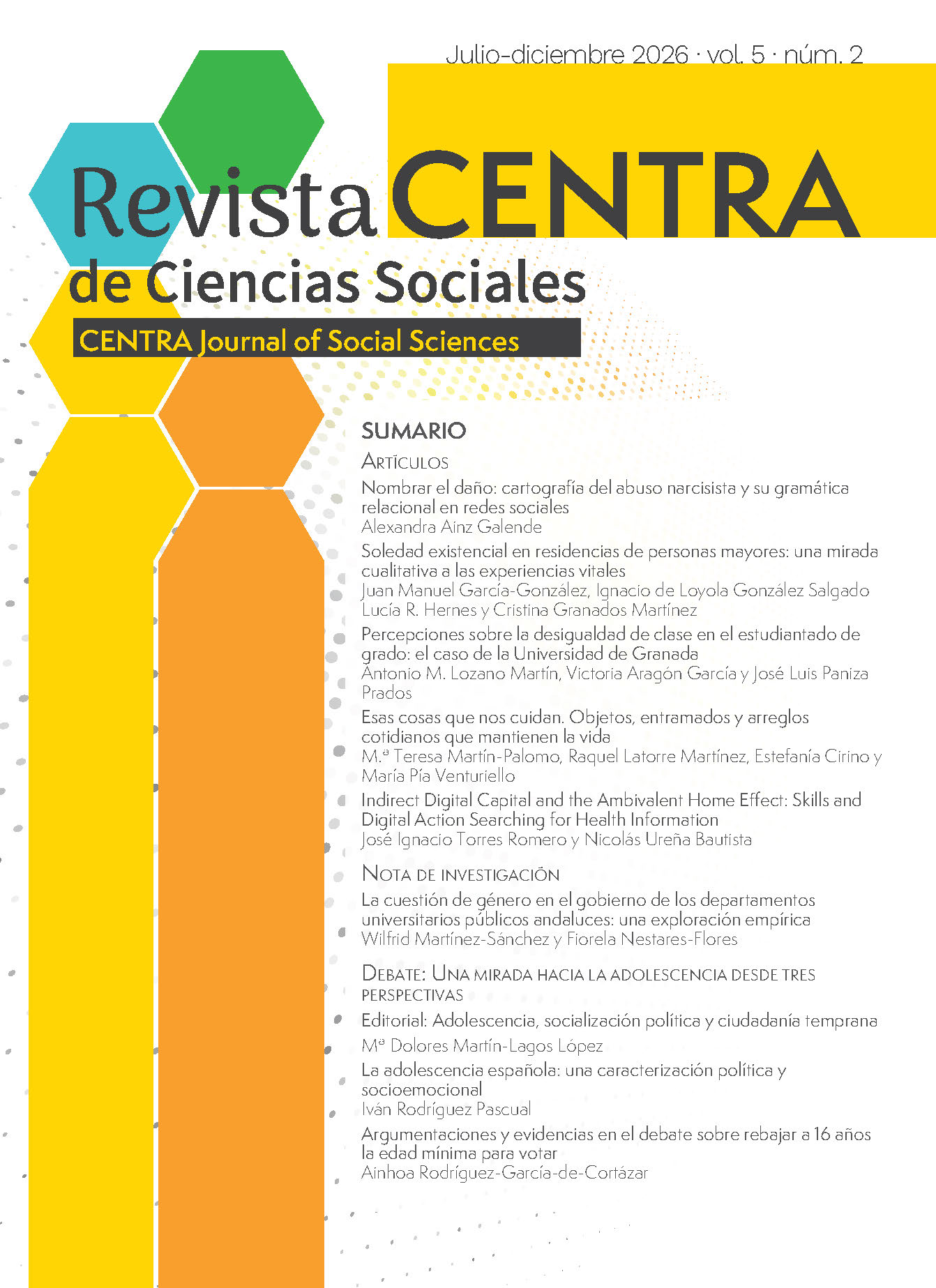
Indirect Digital Capital and the Ambivalent Home Effect: Skills and Digital Action Searching for Health Information
DOI:
https://doi.org/10.54790/rccs.157Keywords:
digital divide, digital self-efficacy, family, digital capital, digital health literacyAbstract
The research analyses the factors that influence the search for health information online in Andalusia. The survey on digitisation and the use of personal data conducted by the Institute of Statistics and Cartography of Andalusia (2021) was used. Through binary logistic regression analysis, the results show how the intensity and diversity of internet use, as well as the level of self-efficacy and the perception of risks associated with privacy, condition searching for health information on the internet. Finally, these results suggest that digital divides should be analysed from a relational perspective, showing the ambivalence of the phenomenon. Indirect access to digital capital within the home can mitigate the digital exclusion of its members, but without eliminating previous inequalities.
Downloads
Metrics
References
Annick, P. y Savage, M. (2013). Emerging forms of cultural capital. European Societies, 15(2), 246-267. https://doi.org/10.1080/14616696.2012.748930 DOI: https://doi.org/10.1080/14616696.2012.748930
Bericat Alastuey, E. y López Menchón, A. (2006). La brecha digital en Andalucía: Equipamiento y uso de las tecnologías de la información y de la comunicación. Idus.us.es. https://idus.us.es/handle/11441/96126 DOI: https://doi.org/10.54790/actualidad.0090
Bericat Alastuey, E. (2002). Valores tradicionales, modernos y posmodernos en la sociedad andaluza. En Moyano, E. y Pérez-Yruela, Y. (eds.), La sociedad andaluza [2000] (pp. 45-64). IESA.
Blumler, J. y Katz, E. (1974). The uses of mass communications. SAGE Publications.
Bourdieu, P. (1984). Distinction: A social critique of the judgement of taste. Harvard University Press.
Bourdieu, P. (2015). Los tres estados del capital cultural. Sociológica México. http://www.sociologicamexico.azc.uam.mx/index.php/Sociologica/article/view/1043
Cabero-Almenara, J., Barroso-Osuna, J. y Rodríguez-Gallego, M. (2020). La competencia digital del profesorado. Aula Abierta, 49(4), 363-372. DOI: https://doi.org/10.17811/rifie.49.4.2020.363-372
Calderón Gómez, D. (2019). Technological capital and digital divide among young people: An intersectional approach. Journal of Youth Studies, 22(7), 941-958. https://doi.org/10.1080/13676261.2018.1559283 DOI: https://doi.org/10.1080/13676261.2018.1559283
Calderón Gómez, D. (2020). The third digital divide and Bourdieu: Bidirectional conversion of economic, cultural, and social capital to (and from) digital capital among young people in Madrid. New Media and Society, 23(9), 146144482093325. https://doi.org/10.1177/1461444820933252 DOI: https://doi.org/10.1177/1461444820933252
Castells, M., Alborés, J. y Martínez, C. (2008). La era de la información: Economía, sociedad y cultura. Alianza Editorial.
Comisión Europea. (2004). Andalucía contra la fractura digital. https://archive.ph/20180216203239/http://ec.europa.eu/regional_policy/es/projects/s pain/andalusia-against-the-digital-divide
Chá, G. y Mercedes, M. (2020). Telemedicina: Su rol en las organizaciones de salud. Revista Médica Del Uruguay, 36(4), 185-203. DOI: https://doi.org/10.29193/RMU.36.4.9
Chen, W. (2013). The implications of social capital for the digital divides in America. The Information Society, 29(1), 13-25. https://doi.org/10.1080/01972243.2012.739265 DOI: https://doi.org/10.1080/01972243.2012.739265
Chen, W., Li, X., Huang, G. y Straubhaar, J. (2021). If you built a sandbox: How children, network diversity, and community interventions are related to Google Fiber signup in disadvantaged urban communities. Telematics and Informatics, 60, 101580. https://doi.org/10.1016/j.tele.2021.101580 DOI: https://doi.org/10.1016/j.tele.2021.101580
Coleman, J. S. (1988). Social capital in the creation of human capital. American Journal of Sociology, 94(1), S95-120. https://www.jstor.org/stable/2780243 DOI: https://doi.org/10.1086/228943
Crampton, J. W. (2003). The political mapping of cyberspace. University of Chicago. https://doi.org/10.1145/1753171.1753182 DOI: https://doi.org/10.1515/9781474465922
De Marco, S. (2022). El comercio electrónico en España (2019): Un ejemplo de tercera brecha digital. Revista Internacional de Sociología, 80(2), e206. https://doi.org/10.3989/ris.2022.80.2.20.98 DOI: https://doi.org/10.3989/ris.2022.80.2.20.98
De Rivera, J., Gordo López, Á. J., García-Arnau, A. y Díaz-Catalán, C. (2021). Los factores estructurales e intervinientes de la socialización digital juvenil. Una aproximación mediante el método Delphi. Revista Complutense de Educación, 32(3), 415-426. https://doi.org/10.5209/rced.70389 DOI: https://doi.org/10.5209/rced.70389
Di Maggio, P., Hargittai, E., Celeste, C. y Shafer, S. (2004). From unequal access to differentiated use: A literature review and agenda for research on digital inequality. En K. M. Neckerman (Ed.), Social Inequality (pp. 355-400). Russell Sage Foundation.
Dodel, M. y Mesch, G. (2018). Inequality in digital skills and the adoption of online safety behaviors. Information, Communication and Society, 21(5), 712-728. https://doi.org/10.1080/1369118x.2018.1428652 DOI: https://doi.org/10.1080/1369118X.2018.1428652
Dutton, W. y Blank, G. (2013). Cultures of the Internet: The Internet in Britain. Oxford Internet Survey 2013 Report.
Dutton, W. H. y Reisdorf, B. C. (2017). Cultural divides and digital inequalities: Attitudes shaping internet and social media divides. Information, Communication and Society, 22(1), 18-38. https://doi.org/10.1080/1369118x.2017.1353640 DOI: https://doi.org/10.1080/1369118X.2017.1353640
Eastin, M. S. y LaRose, R. (2006). Internet Self-Efficacy and the Psychology of the Digital Divide. Journal of Computer-Mediated Communication, 6(1). https://doi.org/10.1111/j.1083-6101.2000.tb00110.x DOI: https://doi.org/10.1111/j.1083-6101.2000.tb00110.x
Erickson, B. H. (1996). Culture, class, and connections. American Journal of Sociology, 102(1), 217-251. https://www.jstor.org/stable/2782191 DOI: https://doi.org/10.1086/230912
Fang, M., Canham, S., Battersby, L., Sixsmith, J., Wada, M. y Sixsmith, A. (2018). Exploring privilege in the digital divide: implications for theory, policy, and practice. The Gerontologist. https://doi.org/10.1093/geront/gny037 DOI: https://doi.org/10.1093/geront/gny037
García González, F. (2008). La historia de la familia en la Península Ibérica (siglos XVI- XIX). Universidad de Castilla La Mancha.
Gasca-Hurtado, G. P. y Machuca-Villegas, L. (2019). Era de la cuarta revolución industrial. RISTI, 34(10), 9-14. https://doi.org/10.17013/risti.34.0 DOI: https://doi.org/10.17013/risti.34.0
Gatti, F. M., Brivio, E. y Galimberti, C. (2017). “The future is ours too”: A training process to enable the learning perception and increase self-efficacy in the use of tablets in the elderly. Educational Gerontology, 43(4), 209-224. https://doi.org/10.1080/03601277.2017.1279952 DOI: https://doi.org/10.1080/03601277.2017.1279952
George, S., Moran , E., Fish , A. y Ogunyemi, L. (2013). Understanding the Digital Divide in the Clinical Setting: The Technology Knowledge Gap Experienced by U.S. Safety Net Patients during Teleretinal Screening. Studies in Health Technology and Informatics. https://doi.org/10.3233/978-1-61499-289-9-946 DOI: https://doi.org/10.3233/978-1-61499-289-9-946
Gobernado, R. (2009). Andalucia en su contexto: España y Europa. En La modernización regional en España (pp. 15-54). Civitas.
Goggin, G. y Ellis, K. (2020). Disability, communication, and life itself in the COVID-19 pandemic. Health Sociology Review, 29(2), 168-176. https://doi.org/10.1080/14461242.2020.1784020 DOI: https://doi.org/10.1080/14461242.2020.1784020
Goldfarb, A. y Prince, J. (2008). Internet adoption and usage patterns are different: Implications for the digital divide. Information Economics and Policy, 20(1), 2-15. https://doi.org/10.1016/j.infoecopol.2007.05.001 DOI: https://doi.org/10.1016/j.infoecopol.2007.05.001
Goto, R., Watanabe, Y., Yamazaki, A., Sugita, M., Takeda, S., Nakabayashi, M. y Nakamura, Y. (2021). Can digital health technologies exacerbate the health gap? A clustering analysis of mothers’ opinions toward digitizing the maternal and child health handbook. SSM - Population Health, 16, 100935. https://doi.org/10.1016/j.ssmph.2021.100935 DOI: https://doi.org/10.1016/j.ssmph.2021.100935
Granovetter, M. S. (1973). The strength of weak ties. American Journal of Sociology, 78(6), 1360-1380. https://www.jstor.org/stable/2776392 DOI: https://doi.org/10.1086/225469
Hargittai, E. y Hinnant, A. (2008). Digital inequality: Differences in young adults’ use of the internet. Communication Research, 35(5), 602-621. https://doi.org/10.1177/0093650208321782 DOI: https://doi.org/10.1177/0093650208321782
Holt, T. J. (2009). Examining the role of technology in the formation of deviant subcultures. Social Science Computer Review, 28(4), 466-481. https://doi.org/10.1177/0894439309351344 DOI: https://doi.org/10.1177/0894439309351344
Holmes, H., Karampour, K., Richardson, R. y Burgess, G. (2025). Housing, poverty, and digital exclusion: the multiple ways in which digital inequalities and housing inequalities intersect. Housing Studies, 1-21. https://doi.org/10.1080/02673037.2025.2577727 DOI: https://doi.org/10.1080/02673037.2025.2577727
Instituto Nacional de Estadística. (2023). Población que usa internet (en los últimos tres meses). Tipos de actividades realizadas por internet. https://www.ine.es/ss/Satellite?L=es_ESandc=INESeccion_Candcid=1259925528782andp=1254735110672andpagename=ProductosYServicios%2FPYSLayout.
Kontos, E., Blake, K. D., Chou, W.-Y. S. y Prestin, A. (2014). Predictors of eHealth Usage: Insights on The Digital Divide from the Health Information National Trends Survey 2012. Journal of Medical Internet Research, 16(7), e172. https://doi.org/10.2196/jmir.3117. DOI: https://doi.org/10.2196/jmir.3117
Márquez Fernández, J. M. (2023). Competencias digitales. En J. M. Márquez Fernández (Ed.), Colección Monográficos España Digital 2023 (pp. 1-27). Observatorio Nacional de Tecnología y Sociedad.
Méndez Domínguez, P., Carbonero Muñoz, D., Raya Díez, E. y Castillo, J. (2023). Digital inclusion for social inclusion. Case study on digital literacy. Frontiers in Communication, 8. https://doi.org/10.3389/fcomm.2023.1191995 DOI: https://doi.org/10.3389/fcomm.2023.1191995
Ministerio de Asuntos Económicos y Transformación Digital. (2022). Cobertura de banda ancha en España en el año 2022. En Informe de cobertura banda ancha a 30 de junio de 2022. Gobierno de España.
Moreno, L. (2010). Reformas de las políticas de bienestar: Contexto y nuevos riesgos sociales. Csic.es. http://hdl.handle.net/10261/28912
Moyano Estrada, E. y Pérez Yruela, M. (1999). Informe social de Andalucía (1978-98): Dos décadas de cambio social. Instituto de Estudios Sociales Avanzados de Andalucía (IESA). https://dialnet.unirioja.es/servlet/libro?codigo=574898
Park, N., Lee, K. M. y Cheong, P. H. (2007). University instructors’ acceptance of electronic courseware: An application of the Technology Acceptance Model. Journal of Computer-Mediated Communication, 13(1), 163-186. https://doi.org/10.1111/j.1083-6101.2007.00391.x DOI: https://doi.org/10.1111/j.1083-6101.2007.00391.x
Park, N. (2010). Adoption and use of computer-based Voice over Internet Protocol phone service: Toward an integrated model. Journal of Communication, 60(1), 40-72. https://doi.org/10.1111/j.1460-2466.2009.01440.x DOI: https://doi.org/10.1111/j.1460-2466.2009.01440.x
Park, S. (2017). Digital capital. Palgrave Macmillan UK. https://doi.org/10.1057/978-1-137- 59332-0
Park, J. y Feng, Y. (2023). Trajectory tracking of changes digital divide prediction factors in the elderly through machine learning. Plos One, 18(2), e0281291. https://doi.org/10.1371/journal.pone.0281291 DOI: https://doi.org/10.1371/journal.pone.0281291
Parlamento Europeo. (2006). Consejo europeo en Viena 11 y 12 de diciembre de 1998. Conclusiones de la presidencia. https://www.europarl.europa.eu/summits/wie1_es.htm
Peter, J. y Valkenburg, P. M. (2006). Adolescents’ internet use: Testing the ‘disappearing digital divide’ versus the ‘emerging digital differentiation’ approach. Poetics, 34(4-5), 293-305. https://doi.org/10.1016/j.poetic.2006.05.005 DOI: https://doi.org/10.1016/j.poetic.2006.05.005
Pizzi, A., Pecourt, J. y Rius-Ulldemolins, J. (2023). De la ‘brecha digital’ al control de internet: Usos, actitudes y participación digital en España. RES, 32(3), a178-178. https://doi.org/10.22325/fes/res.2023.178 DOI: https://doi.org/10.22325/fes/res.2023.178
Prensky, M. (2001). Digital natives, digital immigrants. On the Horizon, 9(5), 1-6. https://doi.org/10.1108/10748120110424816 DOI: https://doi.org/10.1108/10748120110424816
Ragnedda, M. (2017). The third digital divide: A Weberian approach to digital inequalities. Routledge. DOI: https://doi.org/10.4324/9781315606002
Ragnedda, M. (2018). Conceptualizing digital capital. Telematics and Informatics, 35(8), 2366-2375. https://doi.org/10.1016/j.tele.2018.10.006 DOI: https://doi.org/10.1016/j.tele.2018.10.006
Ragnedda, M., Ruiu, M. y Addeo, F. (2019). Measuring digital capital: an empirical investigation. New Media & Society, 22(5), 793-816. https://doi.org/10.1177/1461444819869604 DOI: https://doi.org/10.1177/1461444819869604
Ragnedda, M., Addeo, F. y Ruiu, M. L. (2022). How offline backgrounds interact with digital capital. New Media and Society, 0(0), 146144482210826. https://doi.org/10.1177/14614448221082649 DOI: https://doi.org/10.1177/14614448221082649
Ragnedda, M. y Mushert, G. W. (2017). Theorizing digital divides. Routledge.
Rojas, V., Straubhaar, J., Spence, J., Roychowdhury, D., Okur, Ö., Piñón, J. y Fuentes- Bautista, M. (2012). Communities, cultural capital, and digital inclusion: Ten years of tracking techno-dispositions and techno-capital. University of Texas Press EBooks, 223-264. https://doi.org/10.7560/728714-010 DOI: https://doi.org/10.7560/728714-010
Román-García, S., Almansa-Martínez, A. y Cruz-Díaz, M. R. (2016). Adults and elders and their use of ICTs: Media competence of digital immigrants. Comunicar, 24(4), 101-110. https://doi.org/10.3916/c49-2016-10 DOI: https://doi.org/10.3916/C49-2016-10
Robles, J. M., Torres Albero, C. y Molina Molina, O. (2023). La brecha digital: Un análisis de las desigualdades tecnológicas en España. Sistema: Revista de Ciencias Sociales(218), 3-22. https://dialnet.unirioja.es/servlet/articulo?codigo=3281409
Sassen, S. (2001). Global cities and global city-regions: A comparison. Oxford University Press EBooks, 78-95. https://doi.org/10.1093/oso/9780198297994.003.0007 DOI: https://doi.org/10.1093/oso/9780198297994.003.0007
Selwyn, N. (2004). Reconsidering political and popular understandings of the digital divide. New Media and Society, 6(3), 341-362. https://doi.org/10.1177/1461444804042519 DOI: https://doi.org/10.1177/1461444804042519
Selwyn, N. (2006). Digital division or digital decision? A study of non-users and low-users of computers. Poetics, 34(4-5), 273-292. https://doi.org/10.1016/j.poetic.2006.05.003 DOI: https://doi.org/10.1016/j.poetic.2006.05.003
Selwyn, N. (2010). Degrees of digital division: Reconsidering digital inequalities and contemporary higher education. Universities and Knowledge Society Journal, 7(1). https://doi.org/10.7238/rusc.v7i1.660 DOI: https://doi.org/10.7238/rusc.v7i1.660
Shaw, J. y Glover, W. (2024). The Political Economy of Digital Health Equity: Structural Analysis. Journal of Medical Internet Research, 26(1), e46971. https://doi.org/10.2196/46971 DOI: https://doi.org/10.2196/46971
Thomas, D. (2003). Hacker culture. University of Minnesota Press.
Torres Albero, C. (2017). Sociedad de la información y brecha digital en España. Panorama Social (25), 17-33. https://dialnet.unirioja.es/servlet/dcart?info=linkandcodigo=6371386andorden=0
Varela, J. (2015). La brecha digital en España. Estudio sobre la desigualdad postergada. Comisión Ejecutiva Confederal de UGT.
Van Deursen, A., Helsper, E., Eynon, R. y Van Dijk, J. (2017). The compoundness and sequentiality of digital inequality. International Journal of Communication, 11, 452-473.
Van Deursen, A. y Helsper, E. (2015). The third-level digital divide: Who benefits most from being online? Communication and Information Technologies Annual, 10, 29-52. https://doi.org/10.1108/s2050-206020150000010002 DOI: https://doi.org/10.1108/S2050-206020150000010002
Van Deursen, A. y van Dijk, J. (2015). New media and the digital divide. International Encyclopedia of the Social and Behavioral Sciences, 787-792. https://doi.org/10.1016/b978-0-08-097086-8.95086-4 DOI: https://doi.org/10.1016/B978-0-08-097086-8.95086-4
Vázquez Carretero, E. (2017). Brecha digital en Andalucía; TIC, sociedad y territorio. Análisis y propuestas en el ámbito de las infraestructuras (PhD thesis).
Venkatesh, V., Morris, M., Davis, G. y Davis, F. (2003). User acceptance of information technology: Toward a unified view. MIS Quarterly, 27(3), 425-478. https://doi.org/10.2307/30036540 DOI: https://doi.org/10.2307/30036540
Yruela, M. P. (2002). Para una nueva teoría de Andalucía. Cambio y modernización en la sociedad andaluza. La Sociedad Andaluza [2000], Córdoba. https://idus.us.es/handle/11441/56022
Willekens, M., Siongers, J. y Lievens, J. (2022). Social stratification and social media disengagement: The effect of economic, cultural and social capital on reasons for non-use of social media platforms. Poetics, 101708. https://doi.org/10.1016/j.poetic.2022.101708 DOI: https://doi.org/10.1016/j.poetic.2022.101708
Downloads
Published
How to Cite
Issue
Section
License
Copyright (c) 2026 José Ignacio Torres Romero, Nicolás Ureña Bautista

This work is licensed under a Creative Commons Attribution-NonCommercial-ShareAlike 4.0 International License.
Funding data
-
Universidad de Málaga
Grant numbers PID2020-115673RB-I00 -
Universidad de Málaga
Grant numbers PID2023-147856OB-I00