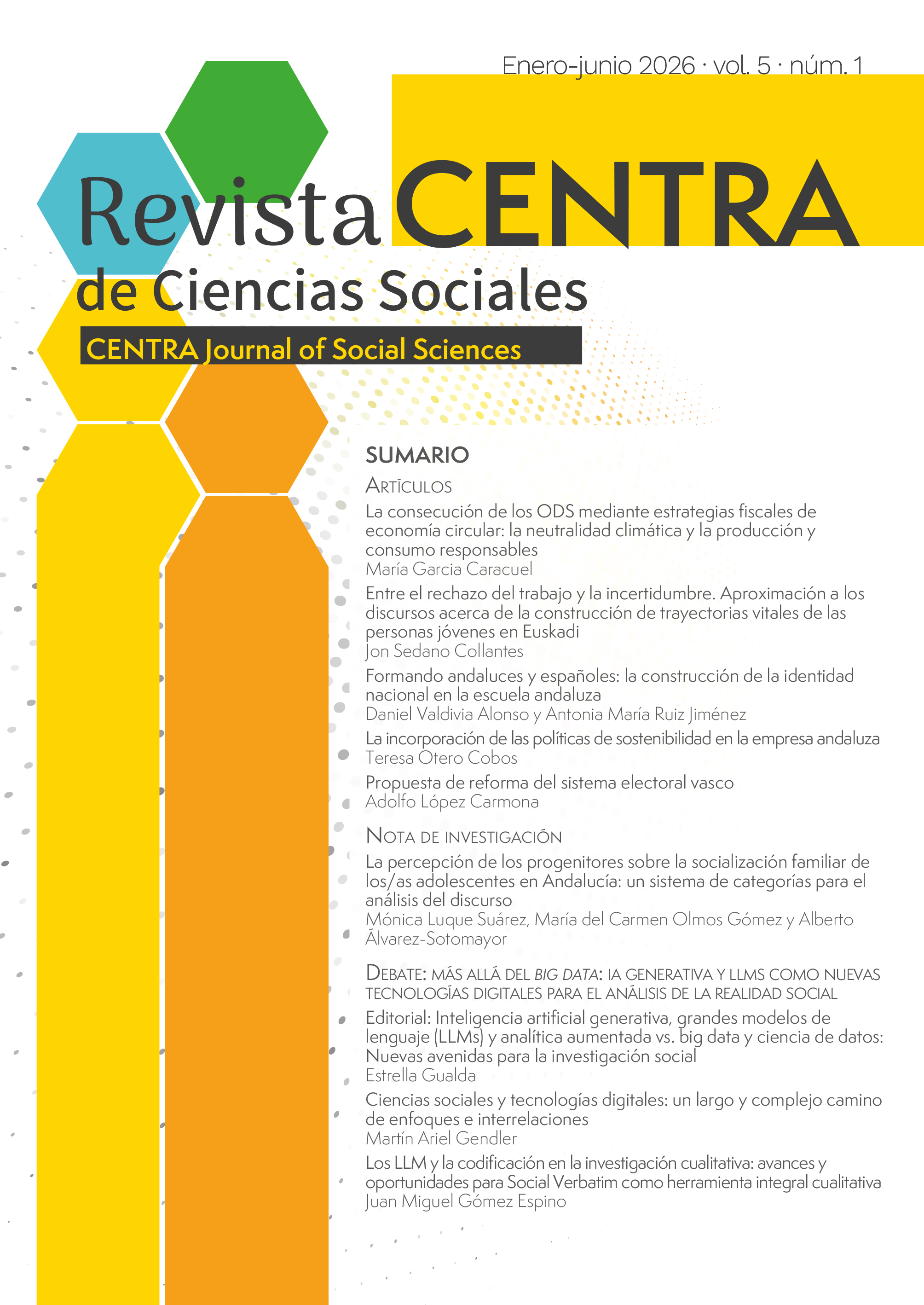
Editorial: Inteligencia artificial generativa, grandes modelos de lenguaje (LLMs) y analítica aumentada vs. big data y ciencia de datos: Nuevas avenidas para la investigación social
DEBATE: Más allá del Big Data: IA Generativa y LLMs como nuevas tecnologías digitales para el análisis de la realidad social
DOI:
https://doi.org/10.54790/rccs.150Palabras clave:
inteligencia artificial, inteligencia de negocios, ciencia de datos, macrodatos, modelos grandes de lenguaje, inteligencia generativa, analítica aumentada, Web of Science, mapas de conocimiento, publicaciones científicas, ciencias socialesResumen
Este artículo examina comparativamente la evolución de campos y tecnologías como la inteligencia artificial, la inteligencia de negocios, la ciencia de datos, los big data, los grandes modelos de lenguaje (LLMs), la inteligencia generativa y la analítica aumentada. A partir de los documentos «más citados» y «candentes» de WoS, analiza redes de co-ocurrencias de términos, visualizando un mapa de conocimiento donde se observan temas o conceptos clave de esta bibliografía y sus conexiones. En el último lustro se aprecia una tendencia a la reducción relativa de las publicaciones científicas sobre la inteligencia de negocios, big data o ciencia de datos en comparación con las publicaciones sobre LLMs —como ChatGPT—, inteligencia generativa y analítica aumentada. Se anticipa una interesante diversidad de oportunidades e impactos para las ciencias sociales, como muestran con detalle los artículos incluidos en esta sección de Debate de la Revista CENTRA de Ciencias Sociales.
Descargas
Métricas
Citas
Chiu, T. K. F. (2023). The impact of Generative AI (GenAI) on practices, policies and research direction in education: a case of ChatGPT and Midjourney. Interactive Learning Environments, 32(10), 6187-6203. https://doi.org/10.1080/10494820.2023.2253861 DOI: https://doi.org/10.1080/10494820.2023.2253861
Cobo, M. J., López-Herrera, A. G., Herrera-Viedma, E. y Herrera, F. (2011). An approach to detecting, quantifying, and visualizing the evolution of a research field: A practical application to the Fuzzy Sets Theory field. Journal of Informetrics, 5(1), 146-166. https://doi.org/10.1016/j.joi.2010.10.002 DOI: https://doi.org/10.1016/j.joi.2010.10.002
Codd, E. F. (1970). A relational model of data for large shared data banks. Commun. ACM 13, 6 (junio), 377-387. https://doi.org/10.1145/362384.362685 DOI: https://doi.org/10.1145/362384.362685
Cooper, G. (2023). Examining Science Education in ChatGPT: An Exploratory Study of Generative Artificial Intelligence. Journal of Science Education and Technology, 32, 444-452. https://doi.org/10.1007/s10956-023-10039-y DOI: https://doi.org/10.1007/s10956-023-10039-y
Gendler, M. A. (2026). Ciencias sociales y tecnologías digitales: un largo y complejo camino de enfoques e interrelaciones. Revista Centra de Ciencias Sociales, 5(1), 171-192. https://doi.org/10.54790/rccs.175 DOI: https://doi.org/10.54790/rccs.175
Gómez Espino, J. M. (2026). Los LLM y la codificación en la investigación cualitativa: avances y oportunidades para Social Verbatim como herramienta integral cualitativa. Revista Centra de Ciencias Sociales, 5(1), 193-216. https://doi.org/10.54790/rccs.176 DOI: https://doi.org/10.54790/rccs.176
Gualda, E. (2025). Inteligencia artificial generativa, grandes modelos de lenguaje (LLMs) y analítica aumentada vs. big data y ciencia de datos: Nuevas avenidas para la investigación social — Dataset (XLSX), Script (R) y Visualización HTML (Plotly) - Materiales complementarios [Data set]. Zenodo. https://doi.org/10.5281/zenodo.17298490
Harrer, S. (2023). Attention is not all you need: the complicated case of ethically using large language models in healthcare and medicine. EBioMedicine, 90, 104512. https://doi.org/10.1016/j.ebiom.2023.104512 DOI: https://doi.org/10.1016/j.ebiom.2023.104512
Luhn, H. P. (1958). A Business Intelligence System. IBM Journal of Research and Development, 2, 4, 314-319. https://doi.org/10.1147/rd.24.0314 DOI: https://doi.org/10.1147/rd.24.0314
Meskó, B. (2023). Prompt Engineering as an Important Emerging Skill for Medical Professionals: Tutorial. Journal of Medial Internet Research, 4, 25, e50638. https://doi.org/10.2196/50638 DOI: https://doi.org/10.2196/50638
Mills, C. W. (1959). La imaginación sociológica. México: Fondo de Cultura Económica.
Mügge, D. (2024). EU AI sovereignty: for whom, to what end, and to whose benefit? Journal of European Public Policy, 31(8), 2200-2225. https://doi.org/10.1080/13501763.2024.2318475 DOI: https://doi.org/10.1080/13501763.2024.2318475
Murdoch, B. (2021). Privacy and artificial intelligence: challenges for protecting health information in a new era. BMC Med Ethics, 22, 122. https://doi.org/10.1186/s12910-021-00687-3 DOI: https://doi.org/10.1186/s12910-021-00687-3
Pinto-Coelho, L. (2023). How Artificial Intelligence Is Shaping Medical Imaging Technology: A Survey of Innovations and Applications. Bioengineering, 10(12), 1435. https://doi.org/10.3390/bioengineering10121435 DOI: https://doi.org/10.3390/bioengineering10121435
Ryan, M. (2020). In AI We Trust: Ethics, Artificial Intelligence, and Reliability. Sci Eng Ethics, 26, 2749-2767. https://doi.org/10.1007/s11948-020-00228-y DOI: https://doi.org/10.1007/s11948-020-00228-y
Sætra, H. S. (2023). Generative AI: Here to stay, but for good? Technology in Society, 75, 102372. https://doi.org/10.1016/j.techsoc.2023.102372 DOI: https://doi.org/10.1016/j.techsoc.2023.102372
Skinner, R. E. (2012). Building the Second Mind: 1956 and the Origins of Artificial Intelligence Computing. Smashwords. UC Berkeley. https://escholarship.org/uc/item/88q1j6z3
Van Eck, N. J. y Waltman, L. (2010). Software survey: VOSviewer, a computer program for bibliometric mapping. Scientometrics, 84(2), 523-538. https://doi.org/10.1007/s11192-009-0146-3 DOI: https://doi.org/10.1007/s11192-009-0146-3
Varsha, P. S. (2023). How can we manage biases in artificial intelligence systems – A systematic literature review. International Journal of Information Management Data Insights, 3, 1, 100165. https://doi.org/10.1016/j.jjimei.2023.100165 DOI: https://doi.org/10.1016/j.jjimei.2023.100165
Walter, Y. (2024). Embracing the future of Artificial Intelligence in the classroom: the relevance of AI literacy, prompt engineering, and critical thinking in modern education. Int J Educ Technol High Educ, 21, 15. https://doi.org/10.1186/s41239-024-00448-3 DOI: https://doi.org/10.1186/s41239-024-00448-3
Descargas
Publicado
Cómo citar
Número
Sección
Licencia
Derechos de autor 2026 Estrella Gualda Caballero

Esta obra está bajo una licencia internacional Creative Commons Atribución-NoComercial-CompartirIgual 4.0.