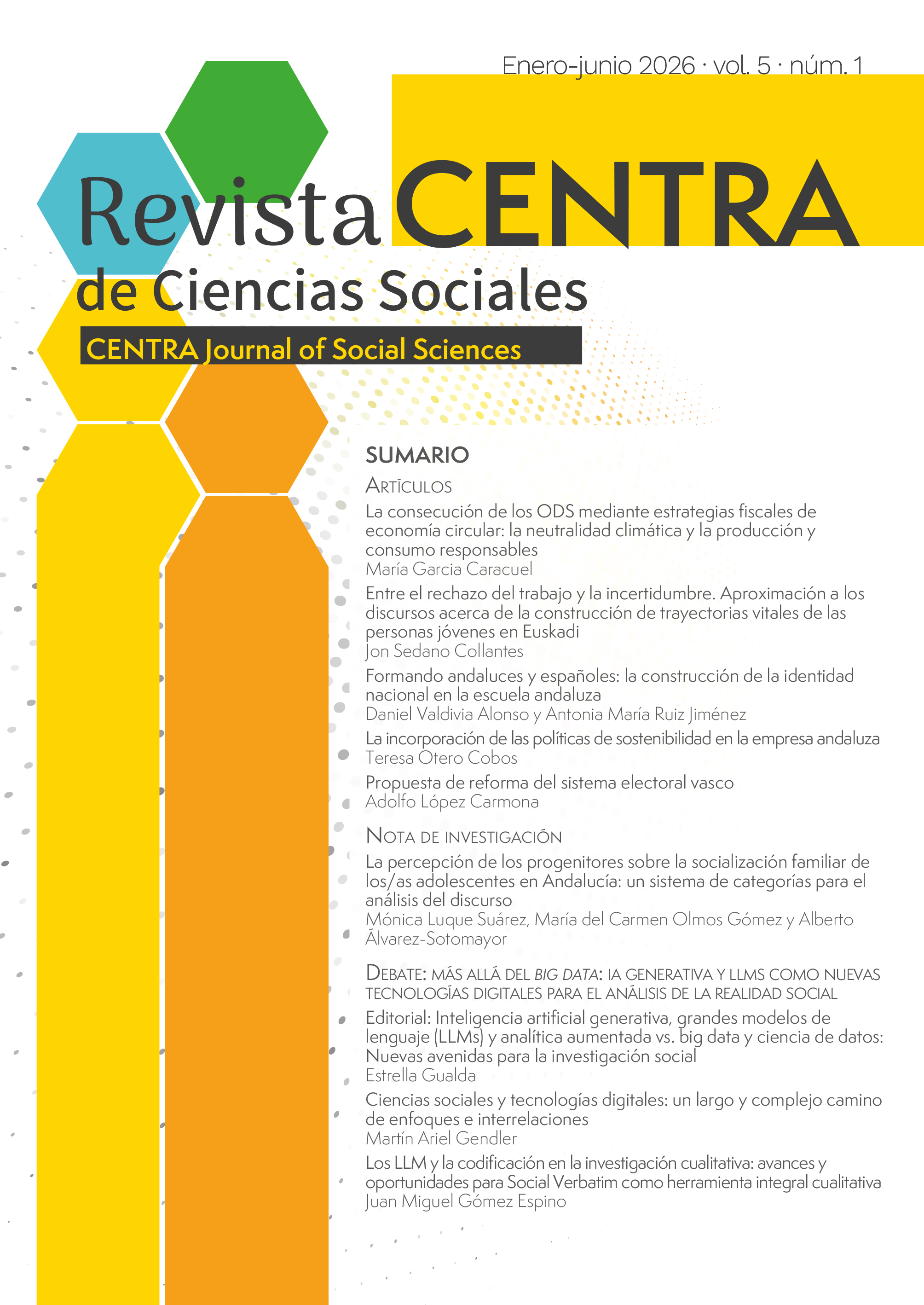
Social Sciences and Digital Technologies: a Long and Complex Path of Approaches and Interrelationships
DEBATE: Beyond Big Data: Generative AI and LLMs as New Digital Technologies for the Analysis of Social Reality
DOI:
https://doi.org/10.54790/rccs.175Keywords:
digital technologies, information and communication technologies, social sciences, computational methodologies, Computational Social Sciences, Digital HumanitiesAbstract
Since the 1970s, the introduction and gradual widespread adoption of digital technologies (DT) have had a significant impact on various political, economic, social, and cultural aspects of society. The social sciences and humanities have not been immune to the effects of these technologies. This article aims to outline the current state of research in the social sciences and humanities concerning digital technologies, analyzing the different approaches that have emerged, their characteristics, differences, and similarities. Based on an extensive literature review, a categorization is proposed to classify the range of approaches related to digital technologies: from primarily theoretical and conceptual approaches; to those focused on analyzing the impacts of digital technologies; to instrumental approaches that involve incorporating computer software packages for methodological techniques; and finally, to the more recent, reflective computational approaches that have made the incorporation of advanced computer techniques their defining characteristic: computational social science and digital humanities.
Downloads
Metrics
References
Bell, D. (1976). El advenimiento de la sociedad post-industrial. Un intento de prognosis social. Madrid: Alianza.
Caro, J., Díaz-de la Fuente, S., Ahedo, V., Zurro, D., Madella, M., Galán, J. M., Izquierdo, L., Santos, J. y Del Olmo, R. (2020). Terra Incognita: Libro blanco sobre transdisciplinariedad y nuevas formas de investigación en el Sistema Español de Ciencia y Tecnología. Madrid: Pressbooks.
Castells, M. (1999). La era de la información. Economía, sociedad y cultura. Madrid: Alianza.
Chow, J. (2015). Comparing the Humanities and Social Sciences in the Digital Age. Digital History and Documentary Film at Lehigh University. https://wordpress.lehigh.edu/lehighdhdocfilm/essays/summer-2015/comparing-the-humanities-and-social-sciences-in-the-digital-age/
Colombrans, J. (1999). Informática aplicada a las Ciencias Sociales. Cuadernos de Etnologia y Etnografia de Navarra, (73), 199-205. https://www.culturanavarra.es/uploads/files/15_CEEN73_0199-0205.pdf
Conte, R., Gilbert, N., Bonelli, G. et al. (2012). Manifesto of computational social science. Eur. Phys. J. Spec. Top., 214, 325-346. https://doi.org/10.1140/epjst/e2012-01697-8 DOI: https://doi.org/10.1140/epjst/e2012-01697-8
Crovi Druetta, D. (2004). Sociedad de la información y el conocimiento, entre lo falaz y lo posible. Buenos Aires: La Crujía.
Foucault, M. (2007). Nacimiento de la biopolítica. Curso en el Collège de France (1978-1979). Buenos Aires: FCE.
Fox, J. (2005). The R Commander: A Basic-Statistics Graphical User Interface to R. Journal of Statistical Software, 14 (9). DOI: https://doi.org/10.18637/jss.v014.i09
Galliano, A. (2024). La máquina ingobernable. Historia de cuatro capitalismos. Buenos Aires: El Gato y la Caja.
Gefen, A., Saint-Raymond, L. y Venturini, T (2020). AI for Digital Humanities and Computational Social Sciences. En B. Braunschweig y M. Ghallab (Eds.), Reflections on AI for Humanity. In press. https://hal.science/hal-03043393v1 DOI: https://doi.org/10.1007/978-3-030-69128-8_12
Gendler, M. (2023). De la cibernética al metaverso: una genealogía de características, transparencias y opacidades algorítmicas. Disparidades. Revista de Antropología, 78(1), e001b. https://doi.org/10.3989/dra.2023.001b DOI: https://doi.org/10.3989/dra.2023.001b
Gendler, M. (2024). Datificación Social e Inteligencia Artificial: ¿hacia un nuevo «salto de escala»? Resonancias. Revista de Filosofía, (17), 121-141. https://doi.org/10.5354/0719-790X.2024.74503 DOI: https://doi.org/10.5354/0719-790X.2024.74503
Gendler, M. y Girolimo, U. (2025). De la primera a la segunda oleada informacional: una genealogía. Revista de estudios sociales sobre derecho y pena, 5. En prensa.
Giles, J. (2012). Computational social science: Making the links. Nature, 488(7412), 448-450. https://doi.org/10.1038/488448a DOI: https://doi.org/10.1038/488448a
Gold, M. (2012). Debates in the digital humanities. Minnesota: UMP. DOI: https://doi.org/10.5749/minnesota/9780816677948.001.0001
Gualda, E. (2022). Social big data, sociología y ciencias sociales computacionales. Empiria. Revista de metodología de ciencias sociales, (53), 147-177. https://doi.org/10.5944/empiria.53.2022.32631 DOI: https://doi.org/10.5944/empiria.53.2022.32631
Gualda Caballero, E., Taboada Villamarín, A. y Rebollo Díaz, C. (2023). Big data y ciencias sociales. Una mirada comparativa a las publicaciones de antropología, sociología y trabajo social. Gazeta de Antropología, 39 (1). https://digibug.ugr.es/handle/10481/79779 DOI: https://doi.org/10.30827/Digibug.79779
Kirschenmaum, M. (2012). What Is Digital Humanities and What’s It Doing in English Departments? En M. Gold (Ed.), Debates in the digital humanities. Minnesota: UMP. DOI: https://doi.org/10.5749/minnesota/9780816677948.003.0001
Lago Martínez, S., Gala, R. y Samaniego, F. (2023). Derechos e internet: el activismo digital en el horizonte Latinoamericano. En R. Cabello y S. Lago Martínez (Eds.), Cultura, ciudadanías y educación en el entorno digital. Buenos Aires: CLACSO.
Lazer, D., Pentland, A., Adamic, L., Aral, S., Barabási, A.-L., Brewer, D., Christakis, N., Contractor, N., Fowler, J., Gutmann, M., Jebara, T., King, G., Macy, M., Roy, D. y Van Alstyne, M. (2009). Social science: Computational social science. Science, 323(5915), 721-723. https://doi.org/10.1126/science.1167742 DOI: https://doi.org/10.1126/science.1167742
Llaudet, E. e Imai, K. (2024). Data Analysis for Social Science: A Friendly and Practical Introduction. Princeton: PUP.
Mattelart, A. (2002). Historia de la sociedad de la información. México: Paidós.
Morales, S. (2009). La apropiación de TIC: una perspectiva. En S. Morales y M. Loyola (Coords.), Los jóvenes y las TIC. Apropiación y uso en educación. Córdoba: UNC.
Negri, S. (2020). El proceso de trabajo y la experiencia de los trabajadores en las plataformas de delivery en la Argentina. Estudios del Trabajo (60).
Parente, D. (2010). Del órgano al artefacto: acerca de la dimensión biocultural de la técnica. La Plata: EDULP. DOI: https://doi.org/10.35537/10915/26681
Piscitelli, A. (2008). Nativos Digitales. Contratexto (16). DOI: https://doi.org/10.26439/contratexto2008.n016.782
Romero Frías, E. y Sánchez González, M. (2014). Ciencias Sociales y Humanidades Digitales Técnicas, herramientas y experiencias de e-Research e investigación en colaboración. Cuadernos del QAC, 16.
San Martín Cantero, D. (2014). Teoría fundamentada y Atlas.ti: recursos metodológicos para la investigación educativa. REDIE, 16 (1).
Sánchez Torres, J., González Zabala, M. y Muñoz, M. (2012). La Sociedad de la Información: Génesis, Iniciativas, Concepto y su Relación con las TIC. UIS Ingenierías, 11 (1).
Sierra Caballero, F. (2020). Ciberactivismo y nuevos movimientos urbanos. La producción del nuevo espacio público en la política contemporánea. Perspectivas de la comunicación, 13 (1), 177-202. DOI: https://doi.org/10.4067/S0718-48672020000100177
Srnicek, N. (2018). Capitalismo de plataformas. Buenos Aires: Caja Negra Editora.
Trilling, D. (2018, enero). Doing Computational Social Science with Python: An Introduction. https://ssrn.com/abstract=2737682
Zhang, J., Wang, W., Xia, F., Lin, Y.-R. y Tong, H. (2020). Data-Driven Computational Social Science: A Survey. Big Data Research, 21. https://doi.org/10.1016/j.bdr.2020.100145 DOI: https://doi.org/10.1016/j.bdr.2020.100145
Downloads
Published
How to Cite
Issue
Section
License
Copyright (c) 2026 Martín Ariel Gendler

This work is licensed under a Creative Commons Attribution-NonCommercial-ShareAlike 4.0 International License.