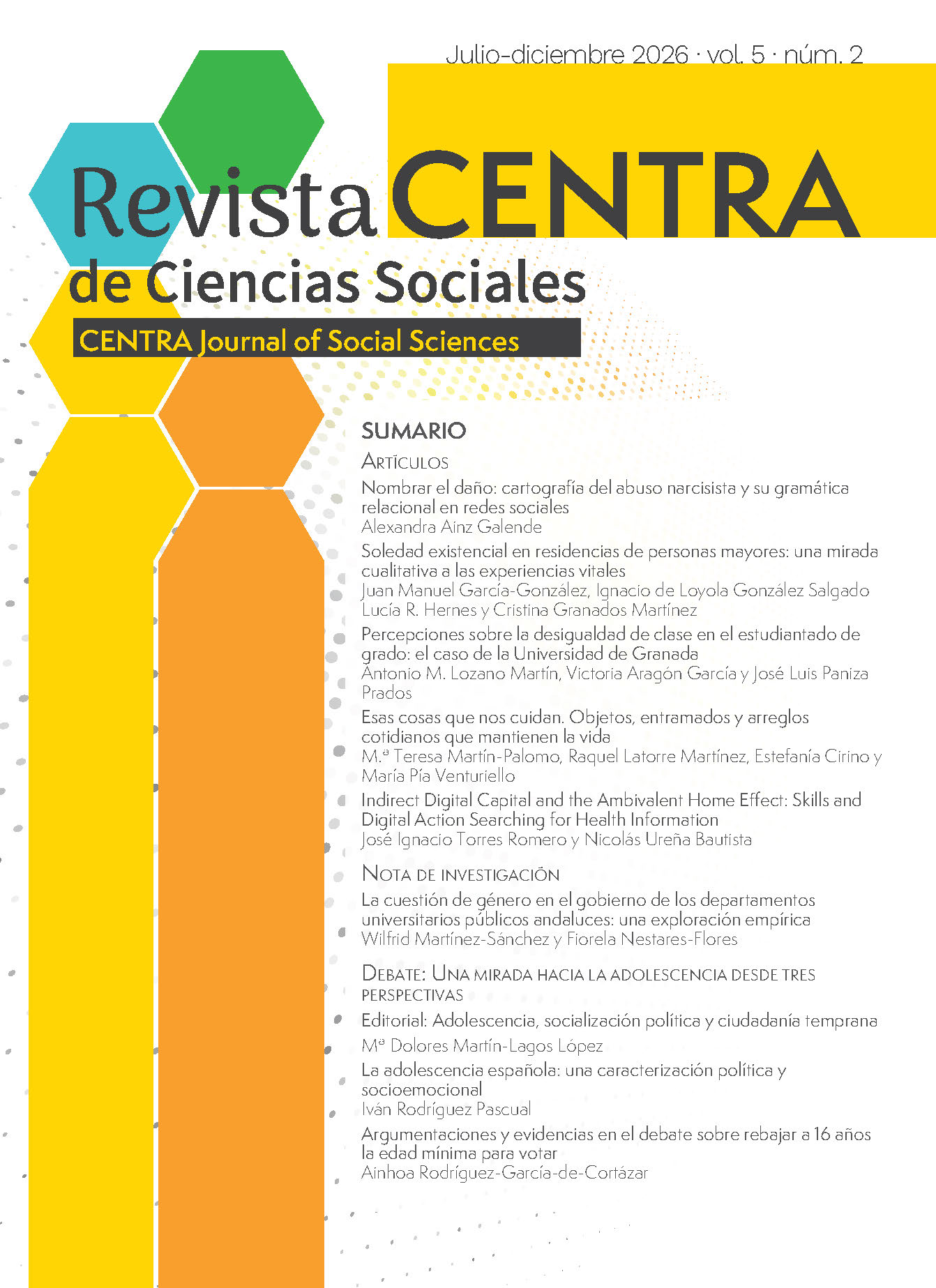
Adolescence in Spain: a Political and Socio-Emotional Analysis
DEBATE: A Look at Adolescence from Three Perspectives
DOI:
https://doi.org/10.54790/rccs.191Keywords:
sociology, adolescence, Spain, survey, gender, ageAbstract
In order to characterise Spanish adolescence in political and socio-emotional terms, we used microdata from the latest INJUVE survey (2023), extracting the subsample corresponding to the population aged 15 to 19 (n=1228). The overall results show a tolerant group, focused on a wide range of social concerns, highly critical on a political level but not conservative. Male adolescents are somewhat more conservative and critical of democracy, reluctant to support the feminist struggle and much more frequent consumers of pornography. Girls show greater exposure to unwanted sexual relations, a more pronounced feeling of loneliness and seem to be more sensitive to certain social problems.
Downloads
Metrics
References
Casas, F. (2010). Representaciones sociales que influyen en las políticas sociales de infancia y adolescencia en Europa. Pedagogía Social. Revista Interuniversitaria, (17), 15-28. DOI: https://doi.org/10.7179/PSRI_2010.17.02
Díez, R. (2025). Los jóvenes en España: ¿se están moviendo a la derecha? Una perspectiva liberal-conservadora. Revista Española de Sociología, 34(3), a273. https://doi.org/10.22325/fes/res.2025.273 DOI: https://doi.org/10.22325/fes/res.2025.273
Duarte, C. (2012). Sociedades adultocéntricas: sobre sus orígenes y reproducción. Ultima década, 20(36), 99-125. https://doi.org/10.4067/S0718-22362012000100005 DOI: https://doi.org/10.4067/S0718-22362012000100005
INJUVE (2024). Informe Juventud en España 2024: entre la emergencia y la resiliencia. INJUVE.
Jafar, M. F. et al. (2025). Navigating the river of knowledge: two decades of unraveling global trends in adolescent wellbeing research. Journal of Education and Learning, 19(2), 831-845. https://doi.org/10.11591/edulearn.v19i2.21275 DOI: https://doi.org/10.11591/edulearn.v19i2.21275
Moreno, C., Rivera F., Sánchez-Queija, I. et al. (2025). La adolescencia española analizada desde el Estudio HBSC-2022: estilos de vida, contextos de desarrollo y bienestar emocional. Informe divulgativo de los resultados más significativos obtenidos. Ministerio de Sanidad.
Oliva, A. (2003). Adolescencia en España a principios del siglo XXI. Culture and Education, 15(4), 373-383. https://doi.org/10.1174/113564003322712947 DOI: https://doi.org/10.1174/113564003322712947
Rodríguez Pascual, I. y Berasategi Sancho, Naiara (2025). Principales resultados del Proyecto INFAPOST. https://infapost.es/wp-content/uploads/2025/07/Informe-Proyecto-Infapost-2025.pdf
Rodríguez, E., Calderón, D., Kuric, S. y Sanmartín, A. (2021). Barómetro Juventud y Género 2021. Identidades, representaciones y experiencias en una realidad social compleja. Madrid: Centro Reina Sofía sobre Adolescencia y Juventud, FAD.
Ruiz Villafranca, R., Tuñón Jiménez, A., Fresno García, J. M., Del Río Hernández, F. y Sonat, D. (2023). Estudio sobre Juventud y soledad no deseada en España. Fundación ONCE-Observatorio Estatal de la Soledad No Deseada.
Shorey, S., Ng, E. D. y Wong, C. H. J. (2022). Global prevalence of depression and elevated depressive symptoms among adolescents: A systematic review and meta-analysis. The British journal of clinical psychology, 61(2), 287-305. https://doi.org/10.1111/bjc.12333 DOI: https://doi.org/10.1111/bjc.12333
Tamarit, A., Schoeps, K., Del Rosario, C., Amador Esparza, N. A. y Montoya-Castilla, I. (2021). Estado de salud en adolescentes de España, México y Chile durante la COVID-19: un estudio transcultural. Acción Psicológica, 18(1), 107-120. https://doi.org/10.5944/ap.18.1.29018 DOI: https://doi.org/10.5944/ap.18.1.29018
Ventura, E. R. (2025). Adolescents in various contexts during the COVID-19 pandemic: A commentary. Journal of Research on Adolescence, 35, e13051. https://doi.org/10.1111/jora.13051 DOI: https://doi.org/10.1111/jora.13051
Downloads
Published
How to Cite
Issue
Section
License
Copyright (c) 2026 Iván Rodríguez Pascual

This work is licensed under a Creative Commons Attribution-NonCommercial-ShareAlike 4.0 International License.