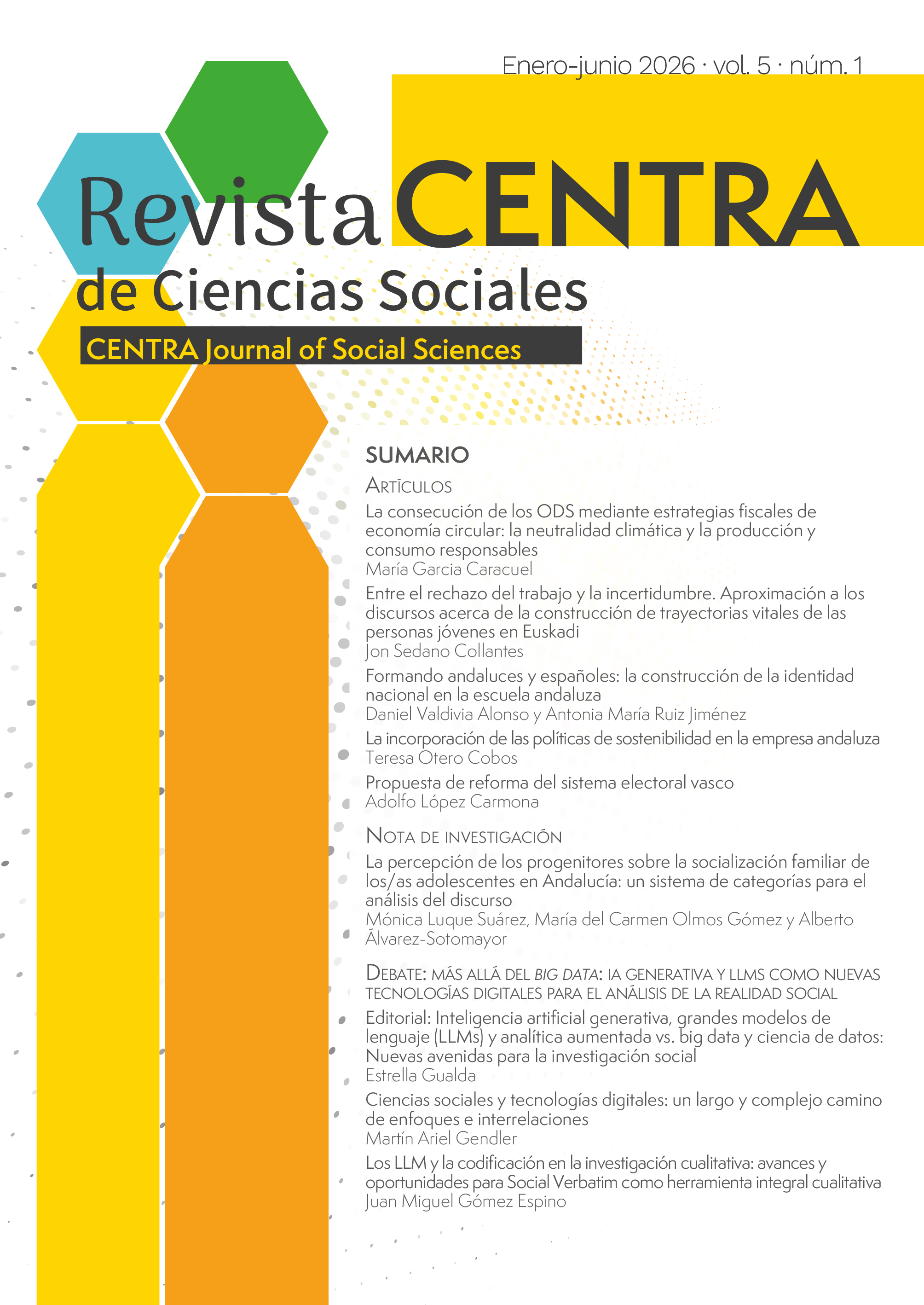
Shaping Andalusians and Spaniards: The Construction of National Identity in Andalusian Schools
A Preliminary Study in the Province of Seville
DOI:
https://doi.org/10.54790/rccs.131Keywords:
national identity, Andalusian identity, education, school, Andalusia, Spain, nationalism, cultural identity, civic identityAbstract
This study analyzes the construction of Andalusian identity in schools and its relationship with Spanish identity. Based on theoretical frameworks on national socialization and identity models (ethno-cultural and civic), the research explores to what extent education in Andalusia fosters a distinct identity, how it relates to Spanish identity, and whether civic or cultural elements predominate in its teaching. The results show that Andalusian schools actively contribute to the reproduction of an Andalusian identity, with a strong emphasis on ethno-cultural elements, while civic aspects play a marginal role. Additionally, Andalusian identity does not appear in opposition to Spanish identity, although Andalusian speech emerges as a distinguishing factor associated with a sense of grievance. Teachers play a crucial role in transmitting these contents.
Downloads
Metrics
References
Aguiar, F. y Espinosa de los Monteros, E. (2009). Identidad andaluza y realidad nacional. Córdoba: IESA-CSIC. Informes y documentos de trabajo, 1-22. http://hdl.handle.net/10261/37003
Altamirano, M. (2020). Pedagogía y resistencia: la escuela como espacio de disputa cultural. Buenos Aires: Siglo XXI.
Álvarez Junco, J. (2001). Mater Dolorosa. Madrid: Taurus.
Anderson, B. (1983). Imagined communities: reflections on the origin and spread of nationalism. London: Verso.
Apple, M. W. (2004). Ideology and Curriculum. London: Routledge. DOI: https://doi.org/10.4324/9780203487563
Brubaker, R. (2009). Ethnicity, race, and nationalism. Annual Review of Sociology, 35(1), 21-42. DOI: https://doi.org/10.1146/annurev-soc-070308-115916
Carranza, G. G. (2016). La identidad estatal plurinacional como elemento cohesionante (y no diferenciador) de la ciudadanía. Revista de la Facultad de Derecho, (39), 39-61. https://doi.org/10.22187/201522 DOI: https://doi.org/10.22187/201522
Coller, X. (2014). Perspectivas sobre la identidad andaluza: Políticos, intelectuales y ciudadanía. Sevilla: Centro de Estudios Andaluces.
Conversi, D. (1997). The Basques, the Catalans and Spain: Alternative Routes to Nationalist Politics. Nevada: University of Nevada Press.
Del Campo, E. y López, E. (2015). Modelos educativos y políticas de educación secundaria en Andalucía, Madrid y País Vasco: problemas, agendas y decisiones. Gestión y Análisis de Políticas Públicas, 34(1), 1-16. https://doi.org/10.24965/gapp.v0i13.10236 DOI: https://doi.org/10.24965/gapp.v0i13.10236
Delgado, A. (2022). La enseñanza de la Historia y los debates parlamentarios en la reforma educativa de la LOMLOE. Ayer. Revista de Historia Contemporánea, 125(1), 17-42. https://doi.org/10.55509/ayer/975 DOI: https://doi.org/10.55509/ayer/975
Díez Medrano, J. y Gutiérrez, P. (2001). Nested identities: national and European identity in Spain. Ethnic and racial studies, 24(5), 753-778. https://doi.org/10.1080/01419870120063963 DOI: https://doi.org/10.1080/01419870120063963
Doncel, D. (2008). Construcción de identidades colectivas culturales a través del sistema educativo: Comunidades autónomas y LOGSE. Revista Española de Educación Comparada, (14), 207-241.
Doncel, D. (2016). Identidad cultural autonómica en el sistema educativo español. Berceo, (171), 35-58.
Easton, D. (1975). A Re-Assessment of the Concept of Political Support. British Journal of Political Science, 5(4), 435-457. DOI: https://doi.org/10.1017/S0007123400008309
Espinosa, A. y Tapia, G. (2011). Identidad nacional como fuente de bienestar subjetivo y social. Boletín de Psicología, 102(2), 71-87.
Fishman, J. A. (1972). The Sociology of Language: An Interdisciplinary Social Science Approach to Language in Society. Cork: Newbury House.
García, F. F. y Merchán, J. (2015). La construcción de la identidad nacional en las escuelas de Andalucía. En B. Falaize, C. Heimberg y O. Loubes (Eds.), L’Escola i la nació (pp. 111-119). ENS Editions.
García-Segura, S. (2022). Estado nación e identidad nacional: América Latina y la gestión de la diversidad en contextos multiculturales. Diálogo andino, 67, 170-182. http://dx.doi.org/10.4067/S0719-26812022000100170 DOI: https://doi.org/10.4067/S0719-26812022000100170
Gellner, E. (1983). Nations and Nationalism. New York: Cornell University Press.
Goodson, I. F. (2014). Curriculum, Narratives and the Social Future. London: Routledge. DOI: https://doi.org/10.4324/9780203489345
Green, A. (1990). Education and State formation. The rise of education systems in England, France and the USA. Basingstoke: Macmillan.
Guibernau, M. (2004). Catalan nationalism: Francoism, transition and democracy. London: Routledge. DOI: https://doi.org/10.4324/9780203300251
Habermas, J. (1998). Between Facts and Norms: Contributions to a Discourse Theory of Law and Democracy. Cambridge: MIT Press.
Hargreaves, A. (2004). Teaching in the Knowledge Society: Education in the Age of Insecurity. New York: Teachers College Press.
Hechter, M. (2001). Containing Nationalism. Oxford University Press. https://doi.org/10.1093/019924751X.001.0001 DOI: https://doi.org/10.1093/019924751X.001.0001
Hijano, M. (2000). La cultura andaluza en los libros de texto. Comunicar, 7(14), 153-158. https://doi.org/10.3916/C14-2000-21 DOI: https://doi.org/10.3916/C14-2000-21
Hijano, M. y Ruiz, M. (2016) Descentralización educativa y comunidades autónomas: el caso andaluz (1982-1986). Revista Fuentes, 18, 49-63. http://dx.doi.org/10.12795/revistafuentes.2016.18.1.03 DOI: https://doi.org/10.12795/revistafuentes.2016.18.1.03
Hobsbawm, E. J. (1992). Nations and nationalism since 1780: Programme, myth, reality. London: Cambridge University Press. DOI: https://doi.org/10.1017/CCOL0521439612
Keating, M. (2001). So many nations, so few states: territory and nationalism in the global era. En A. G. Gagnon y J. Tully (Eds.), Multinational Democracies (pp. 39-65). Cambridge: Cambridge University Press. DOI: https://doi.org/10.1017/CBO9780511521577.005
Keating, M. (2007). The Independence of Scotland: Self-Government and the Shifting Politics of Union. London: Oxford University Press.
Kleider, H. (2020). Multilevel governance: Identity, political contestation, and policy. The British Journal of Politics and International Relations, 22(4), 792-799. DOI: https://doi.org/10.1177/1369148120936148
Kymlicka, W. (1995). Multicultural Citizenship: A Liberal Theory of Minority Rights. London: Oxford University Press. DOI: https://doi.org/10.1093/0198290918.001.0001
Linz, J. J. y Stepan, A. (1996). Problems of democratic transition and consolidation: Southern Europe, South America, and post-communist Europe. Baltimore: The Johns Hopkins University Press. DOI: https://doi.org/10.56021/9780801851575
Lucas, A. (1986). El proceso de socialización: un enfoque sociológico. Revista Española de Pedagogía, 357-370.
Máiz, R. (2004). Per modum unius: más allá de la dicotomía nacionalismo cívico vs. nacionalismo étnico. En A. Gurrutxaga (Ed.), El presente del Estado-nación (pp. 107-128). Bilbao: Universidad del País Vasco.
Méndez, E. (2003). El habla andaluza en los libros de texto escolares. Cauce: Revista de Filología y su Didáctica, 26, 207-230.
Miley, T. J. (2007). Against the thesis of the “civic nation”: The case of Catalonia in contemporary Spain. Nationalism and Ethnic Politics, 13(1), 1-37. https://doi.org/10.1080/13537110601155734 DOI: https://doi.org/10.1080/13537110601155734
Moreno, I. (2008). La identidad cultural de Andalucía: aproximaciones, mixtificaciones, negacionismo y evidencias. Sevilla: Centro de Estudios Andaluces.
Moreno, L. (2004). Identidades múltiples y mesocomunidades globales. En F. Morata, G. Lacahapelle y S. Paquin (Eds.), Globalización, Gobernanza e Identidades (pp. 229-252). Barcelona: Fundació Carles Pi i Sunyer.
Navarro, C. y Pérez Yruela, M. (2000). Calidad de vida y cambio social. De la polarización social a la axiología en la sociedad andaluza. Revista Internacional de Sociología, 26, 5-38. https://doi.org/10.3989/ris.2000.i26.793 DOI: https://doi.org/10.3989/ris.2000.i26.793
Palacios, L. (2008). La identidad de Andalucía. Aproximación histórica. En F. Arcas y C. García (Eds.), Andalucía y España. Identidad y conflicto en la historia contemporánea (pp. 35-79). Málaga: Fundación Unicaja.
Pérez Yruela, M. (2014). Un relato sobre identidad y vida buena en Andalucía. Sevilla: Centro de Estudios Andaluces. DOI: https://doi.org/10.54790/actualidad.0027
Puelles, Manuel de (1999). Educación e ideología en la España contemporánea. Madrid: Tecnos.
Quiroga, A. (2013). La nacionalización en España. Una propuesta teórica. Ayer, 17-38.
Ruiz, F. (2001). Aproximación a la actitud de docentes y alumnos sobre Andalucía. Revista de Estudios Andaluces, 23, 99-118. https://doi.org/10.12795/rea.2001.i23.06 DOI: https://doi.org/10.12795/rea.2001.i23.06
Sautereau, A. y Faas, D. (2023). Comparing national identity discourses in history, geography and civic education curricula: The case of France and Ireland. European Educational Research Journal, 22(4), 555-571. DOI: https://doi.org/10.1177/14749041221086378
Smith, A. D. (1998). Nationalism and Modernism: A Critical Survey of Recent Theories of Nations and Nationalism. London: Routledge.
Smith, E. (2020). Language as a Facet of Identity: The Cases of Catalonia & Kurdistan. Boulder, CO: University of Colorado.
Stepan, A. C. (1999). Federalism and Democracy: Beyond the U.S. Model. Journal of Democracy, 10(4), 19-34. DOI: 10.1353/jod.1999.0072 DOI: https://doi.org/10.1353/jod.1999.0072
Tamir, Y. (2021). El porqué del nacionalismo. Valencia: Barlin Libros.
Torres Santomé, J. (1991). Currículum oculto. Madrid: Morata.
Tully, J. (1995). Strange Multiplicity: Constitutionalism in an Age of Diversity. London: Cambridge University Press. DOI: https://doi.org/10.1017/CBO9781139170888
Van Dijk, T. A. (1997). Discourse as Structure and Process. Thousand Oaks, CA: SAGE Publications.
Wright, S. (2017). Language Policy and Language Planning: From Nationalism to Globalization. London: Palgrave Macmillan.
Downloads
Published
How to Cite
Issue
Section
License
Copyright (c) 2026 Daniel Valdivia Alonso, Antonia María Ruiz Jiménez

This work is licensed under a Creative Commons Attribution-NonCommercial-ShareAlike 4.0 International License.
Funding data
-
Fundación Pública Andaluza Centro de Estudios Andaluces
Grant numbers PRY 040/22